

Legally Reviewed by Attorney Simon Wiseman on September 22, 2026
 A criminal record can quietly follow you for years, closing doors to jobs, housing, and opportunities you have worked hard to earn. If your case was dismissed, you were acquitted, or adjudication was withheld, Florida law may give you a path to wipe that record clean through expungement.
Attorney Simon Wiseman of Wiseman Law has helped clients across Central Florida pursue expungement and record-sealing relief for cases that once threatened to define their futures. With more than 25 years of experience and a background as a former Orange County prosecutor, he knows how the process works from both sides and how to build the strongest possible case for your eligibility. If a fresh start matters to you, our criminal defense and expungement practice is ready to help you pursue it.
This guide focuses on the eligibility rules and legal effect of expungement under Florida law. If you already know you qualify and want the step-by-step petition workflow, our companion guide on the expungement process and who qualifies walks through each filing stage in more detail.
Who Qualifies for Expungement in Florida?
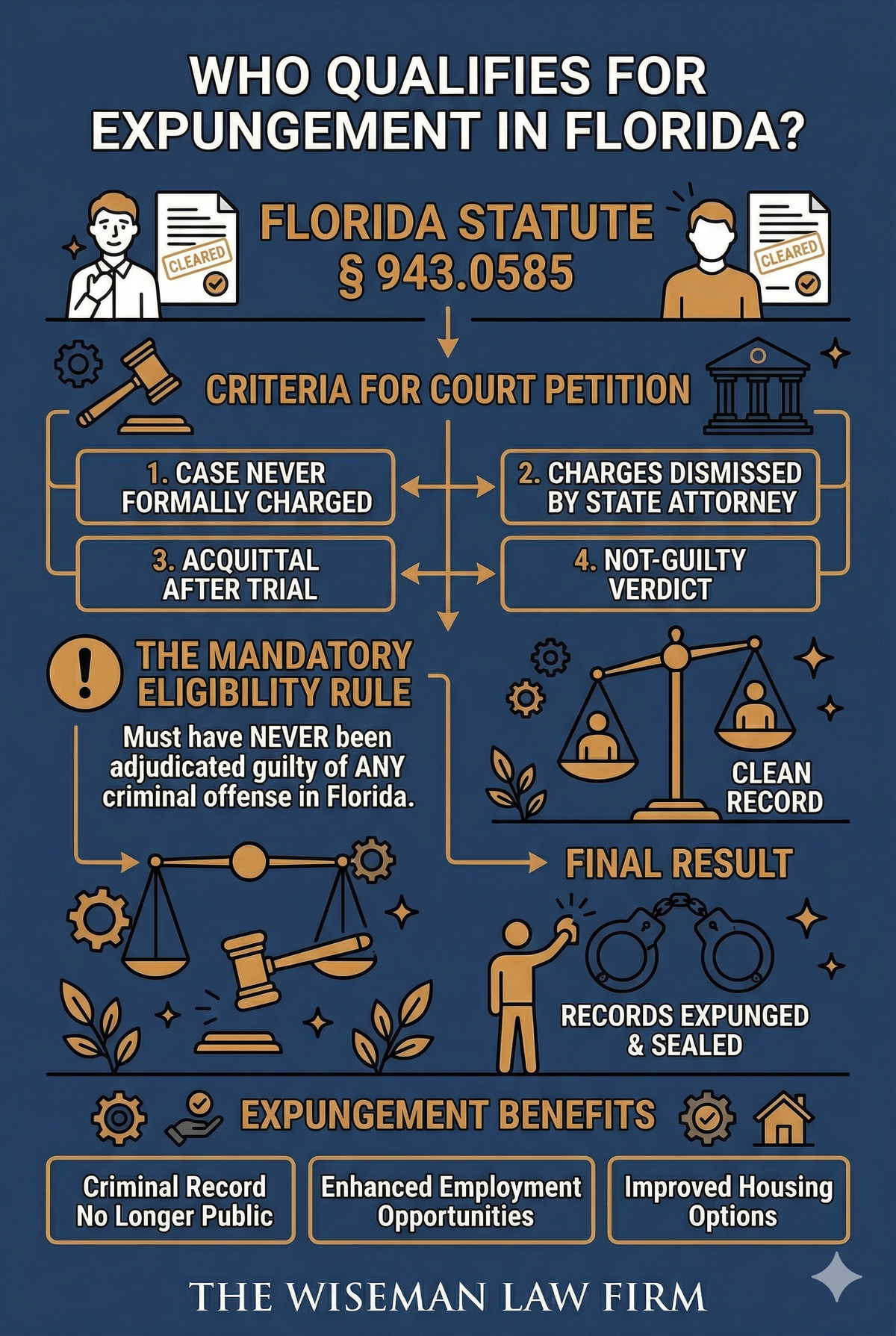
Florida has strict eligibility requirements for expungement, and not every arrest or charge qualifies. Under Florida Statute § 943.0585, a person may petition the court to expunge a criminal history record if the case was never formally charged, was dismissed by the State of Florida, resulted in an acquittal, or ended in a not-guilty verdict. You must also have never been adjudicated guilty of any criminal offense in Florida or any other jurisdiction.
Additional Eligibility Considerations
There are several other conditions that must be met before moving forward. Florida allows only one expungement per person over a lifetime, so this is a one-time opportunity. You generally cannot expunge a record if adjudication was withheld on a prior offense for which you previously received an expungement or sealing. Certain offenses are also categorically ineligible regardless of outcome, including most sex crimes, murder, and aggravated child abuse.
Expungement and sealing are two different remedies worth noting. Sealing a record makes it confidential but does not destroy it, while expungement results in the physical destruction of the record. A Lawyer can help determine which option applies to your situation.
Expungement vs. Sealing: Which Applies to Your Case
Because these two remedies are often confused, it helps to see them side by side:
- Expungement physically destroys most copies of the record, and it is generally reserved for cases resolved without a conviction, such as a dismissal, acquittal, or no filing of charges.
- Sealing keeps the record confidential from the general public but leaves it accessible to certain government agencies and law enforcement, and it may be available in some cases where adjudication was withheld even without a full dismissal.
An eligibility review with a Lawyer can determine which remedy fits your specific disposition before you file anything with the Florida Department of Law Enforcement.
What Changes After Your Record Is Expunged?
Once your record is expunged, you can lawfully deny the arrest ever occurred in most circumstances. This applies to employment applications, housing applications, and background checks run by private employers. However, there are important exceptions. You are still required to disclose an expunged record when applying for positions with law enforcement agencies, seeking licensure in certain regulated industries, or petitioning for Florida Bar admission.
For individuals facing felony charges or those with misdemeanor records, expungement can potentially be a powerful legal tool when it applies. It is especially valuable for clients whose cases were resolved without adjudication but whose records have nonetheless created real-world consequences.
How an Expunged Record Interacts With Other Parts of Your Life
Expungement affects far more than a background check. Landlords, professional licensing boards, and even some volunteer organizations run record checks that an expunged case can lawfully bypass. That said, expungement does not undo every consequence tied to an arrest. If your case involved an illegal search or seizure or other constitutional issues, those issues are addressed in the underlying criminal case itself, not through the expungement petition. Expungement is a records remedy, not a substitute for challenging how a case was built in the first place.
Frequently Asked Questions About Florida Expungement Eligibility
Can I expunge a case if I was found guilty at trial?
No. Expungement under Florida Statute Section 943.0585 requires that the case was not formally charged, was dismissed, or ended in an acquittal or not-guilty verdict. A guilty verdict at trial generally makes a case ineligible for expungement, though sealing may be available in more limited circumstances.
Can I expunge more than one arrest in Florida?
Florida allows only one expungement per person over a lifetime, even if the case involved multiple charges from the same arrest. This is why it matters to have every eligible charge from that arrest addressed in a single petition rather than treating them separately.
Does expungement apply to arrests that never led to formal charges?
Yes, an arrest that never resulted in formal charges being filed by the State of Florida can potentially qualify for expungement. Many people assume that no charges being filed means there is nothing left on their record, but the arrest itself often remains until it is formally expunged.
Who can still see my record after it is expunged?
Even after expungement, certain criminal justice and licensing agencies retain limited access to the record for specific statutory purposes, such as Florida Bar admission, law enforcement hiring, and some professional licensing boards. The general public and most private employers cannot access it.
What is the difference between expungement and having a case dismissed?
A dismissal ends the criminal case itself, but the arrest record can still appear on background checks unless it is separately addressed. Expungement is the additional legal step that removes the arrest record from public view after a qualifying dismissal, acquittal, or decision not to file charges.
Contact Wiseman Law to Discuss Your Eligibility
Attorney Simon Wiseman has successfully handled expungements and dismissals for clients facing everything from drug charges to theft and beyond. His deep knowledge of Florida criminal procedure, combined with his former prosecutorial experience, gives clients a meaningful advantage when navigating the eligibility and petition process.
If you believe you may qualify for expungement, the eligibility rules are strict and unforgiving of small errors. Contact Wiseman Law today to schedule a case evaluation and find out whether expungement is within reach for you.
About the Attorney
Founding Attorney, Wiseman Law
Simon Wiseman is a former Orange County prosecutor with more than 26 years of trial-tested experience in Florida criminal defense and personal injury law. He has tried over one hundred jury and non-jury trials and built Wiseman Law around aggressive, detail-driven representation for clients across Central Florida.