


You don’t have to be holding drugs to be charged with possessing them, and that legal reality catches many people completely off guard. Florida law recognizes two types of drug possession: actual and constructive. Constructive possession is the more complex and often more contested of the two, allowing prosecutors to charge someone with a drug offense even when no substances were found directly on their person. If drugs were found in your car, your home, or a shared space, you may be facing serious charges regardless of whether you ever touched them.
This is exactly why having the right legal advocate in your corner matters. The Wiseman Law Firm has been defending clients against drug charges in Central Florida for over 25 years. Attorney Simon Wiseman is a former Orange County prosecutor who has handled more than 100 jury trials and now uses that insider knowledge to build the strongest possible defense for each client. When facing drug crime charges that hinge on constructive possession, our firm knows what the prosecution is looking for and how to fight back.
 What Constructive Possession Actually Means
 What Constructive Possession Actually Means
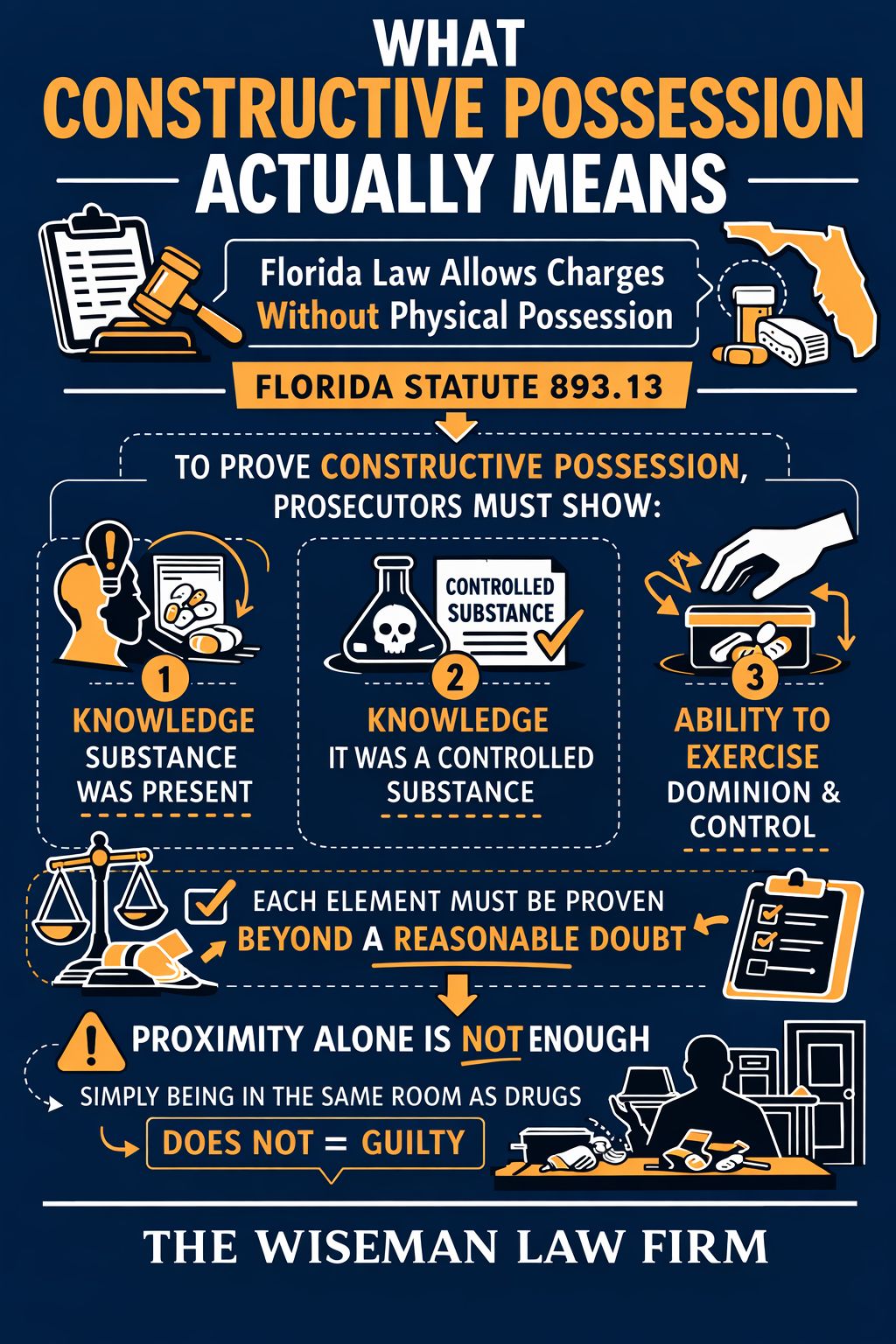
Constructive possession is a legal doctrine allowing the State of Florida to prove possession of a controlled substance without showing the drugs were physically on a person. Under Florida Statute 893.13, a person may not be in actual or constructive possession of a controlled substance. To establish constructive possession, prosecutors must prove three things: that the defendant knew the substance was present, that the defendant knew it was a controlled substance, and that the defendant had the ability to exercise dominion and control over it.
Each element must be proven beyond a reasonable doubt, and that’s where the defense has room to work. Proximity alone is not enough. Simply being in the same room as drugs does not make someone guilty of possession.
Joint Possession and Shared Spaces
One of the most challenging scenarios involves shared spaces, such as a vehicle with multiple passengers or an apartment with multiple occupants. When drugs are found in a location accessible to more than one person, prosecutors cannot simply assume everyone present is equally guilty.
Florida courts have held when contraband is found in a jointly occupied space, the State must show additional incriminating circumstances beyond mere presence to support a constructive possession charge. These circumstances might include evidence the defendant owned the drugs, statements made at the time of arrest, the defendant’s proximity to the contraband, or whether their personal belongings were found alongside it. A passenger whose bag happens to be near a hidden stash is in a very different legal position than someone whose fingerprints are on the packaging.
Common Scenarios Where Constructive Possession Arises
Constructive possession charges come up in a variety of real-world situations. Knowing these scenarios helps clarify why the legal analysis can get complicated quickly.
The following are common circumstances where these charges appear:
- Traffic stops: Police find drugs in a glove compartment, under a seat, or in the trunk, and charge every occupant.
- Rental or borrowed vehicles: Contraband left behind by a prior occupant is discovered during a stop.
- Shared residences: Drugs found in common areas like a living room or kitchen lead to charges against all residents.
- Storage units: Items found in a unit the defendant accessed but did not exclusively control are used as evidence.
Each of these situations requires a thorough investigation into who actually had knowledge and control over the substance in question.
How Florida Courts Evaluate Knowledge and Control
Proving a defendant knew drugs were present is often the weak link in the prosecution’s case. If someone borrowed a friend’s car and had no reason to know drugs were hidden inside, the knowledge element may be difficult to establish. Similarly, if multiple people had equal access to a location, the prosecution must connect a specific defendant to the contraband in a meaningful way.
Evidence like text messages, surveillance footage, cash, paraphernalia, and witness statements all play a role in how these cases unfold. The defense, in turn, may challenge how evidence was gathered. If law enforcement conducted an illegal search, any resulting evidence may be suppressible. Our firm has substantial experience with illegal search and seizure issues and uses every available avenue to protect our clients’ rights.
It’s also worth noting constructive possession charges are not limited to one drug type. They appear regularly in prescription drug cases and in more serious felony matters involving substances like methamphetamine, where the stakes and penalties are significantly higher.
Contact The Wiseman Law Firm for a Defense Strategy
Constructive possession cases are built on inferences, and inferences can be challenged. A skilled defense attorney will scrutinize every aspect of how the drugs were found, who had genuine access to the location, and whether the State can truly prove all required elements beyond a reasonable doubt.
If you or someone you know is facing drug possession charges in Orlando or the surrounding areas, The Wiseman Law Firm is ready to help. Attorney Simon Wiseman brings more than a quarter century of trial experience to every case, and we are available 24 hours a day to provide the aggressive, personalized defense you deserve. Contact our firm today to schedule a case evaluation.